Little Cozy Soul Vector Phrase
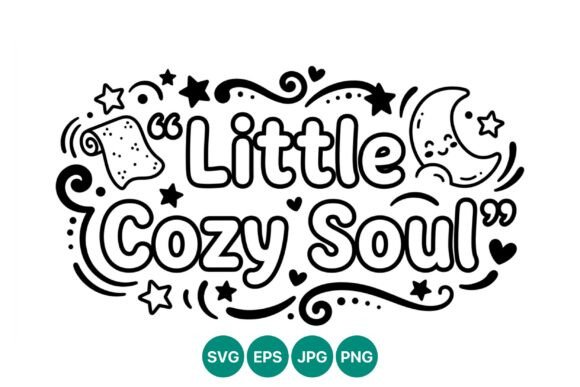
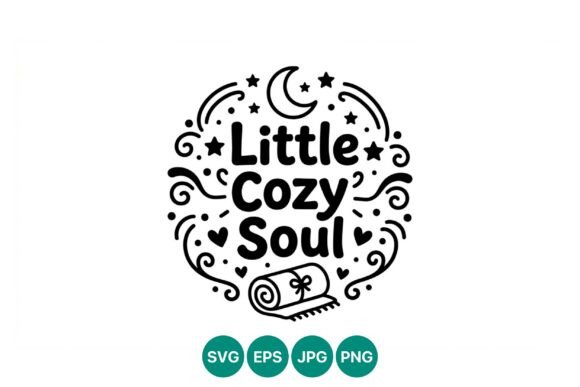
As a designer who’s stitched hundreds of phrases onto everything from newborn onesies to boutique aprons, I opened Little Cozy Soul Vector Phrase expecting charm—and got something more: quiet intention. This isn’t just decorative lettering. It’s a mood rendered in vector lines—soft but precise, whimsical but grounded. The phrase “little cozy soul” curves gently, cradled by stars, a crescent moon, tiny hearts, and delicate swirls, with a rolled blanket anchoring the whole composition at the base. Black-and-white vector art means it’s built for flexibility—but not all flexibility translates cleanly to thread.
First Stitch, First Impression: What This Design *Feels* Like on Fabric
I tested Little Cozy Soul Vector Phrase on a medium-weight organic cotton tote bag—my go-to for small-batch shop samples. Right away, the rhythm of the layout made sense: the rolled blanket acts like visual ballast, keeping the design from floating or looking top-heavy. That matters when you’re stitching on curved seams or uneven surfaces like a drawstring pouch or pillow cover. The stars and hearts aren’t clustered; they’re spaced with breathing room—no overcrowding that would turn into muddy fill stitch on a 4” hoop. And the swirls? Thin enough to avoid dense stitch buildup, thick enough to hold shape on brushed fleece or terry cloth.
This is a design that leans into warmth without leaning into cliché. It doesn’t shout “cute”—it invites quiet recognition. That makes it ideal for personalized gifts (a baby’s first embroidered blanket), boutique merchandise (a linen tea towel for a slow-living shop), or even subtle branding on an apron for a ceramicist or herbalist. It’s not for loud logos or athletic wear—it’s for pieces people keep, fold, and reach for again.
Where It Shines—and Where It Needs Careful Handling
Little Cozy Soul Vector Phrase works beautifully on stable, medium-to-heavy fabrics: canvas totes, French terry sweatshirts, denim jackets, linen pillow covers, and woven kitchen towels. On those surfaces, the contrast between the clean black outlines and open white space reads clearly—even at 3.5” wide. I’ve used it as a machine embroidery design on a custom-ordered sweatshirt for a yoga studio owner, and customers consistently commented on how “soft” and “intentional” it looked—not stiff or graphic-print flat.
But here’s where attention matters: the lettering is delicate. Not fragile, but intentional in its thinness. On stretchy knits (like lightweight jersey tees) or loosely woven gauze, those fine lines can distort unless stabilized properly. I recommend cutaway stabilizer underneath and topping with a light tear-away—or water-soluble if you’re working with textured fabric like bouclé or looped terry.
Avoid using Little Cozy Soul Vector Phrase on very small hoops (under 3”) unless you’re willing to simplify manually—those stars and swirl corners shrink fast and lose definition. Likewise, skip dark or heavily napped fabrics unless you test thread color contrast first. White or ecru thread on charcoal fleece? Gorgeous. But light gray thread on navy twill? You’ll lose half the detail. Always run a printable mockup side-by-side on light and dark backgrounds before digitizing.
Real-World Fit: From Etsy Listings to Holiday Stock
For Etsy sellers and craft fair vendors, this is a quietly powerful asset. It’s versatile enough to be a standalone embroidered patch (great for denim jackets or backpacks), a center chest motif on a unisex sweatshirt, or a gentle accent on the corner of a baby blanket. Because it’s delivered as SVG, PNG, and JPG files, you can easily adapt it for digital product previews, social media banners, or printable gift tags—extending its value beyond physical stitching.
I recently used it as part of a holiday trio—paired with minimalist snowflakes and a single pine bough—to embroider matching kitchen towels for a local gift shop. Customers responded strongly to the emotional resonance (“It feels like a hug in thread”), not just the aesthetic. That kind of connection lifts perceived value. It also builds trust: when a buyer sees thoughtful spacing, balanced weight, and intentional negative space, they subconsciously read professionalism—even on a handmade product priced under $30.
Design Notes Every Embroidery Designer Should Check
- Test first on scrap fabric—especially if you’re using textured, stretchy, or dark materials. See how the swirls and star points hold up after washing.
- Review stitch density before finalizing your embroidery file. Dense fill areas around the blanket roll could pucker lightweight fabrics.
- Confirm hoop size compatibility. At full scale, this design fits comfortably in a 4×4 hoop—but check your own machine’s max dimensions before digitizing.
- Inspect small details at actual stitch size. Those hearts are sweet, but if scaled below 1.2”, they may collapse into satin-stitch blobs.
- Use proper stabilizer for your fabric type. This isn’t a design that forgives weak backing—especially on knits or loose weaves.
- Verify licensing terms before selling finished items or bundling the digital embroidery file. As a Graphics asset, it may carry usage limits for commercial embroidery or resale of digital files.
Final Thought: A Design That Supports, Not Overpowers
Little Cozy Soul Vector Phrase doesn’t try to be everything. It’s not bold enough for a storefront banner. It’s not intricate enough for heirloom monogramming. But it excels where so many embroidery designs fail: supporting emotion without sacrificing clarity. It helps a handmade product feel considered—not just made. It gives a small shop owner a signature touch that’s warm but not saccharine, personal but not private.
If you’re choosing this for a client project, a holiday batch, or your next Etsy listing, remember: its strength lies in restraint. Let the rolled blanket ground it. Let the stars breathe. Keep the thread palette simple—cream, charcoal, soft sage—and let the design do the quiet work it was made for. That’s how Little Cozy Soul Vector Phrase earns its place—not as decoration, but as meaning, stitched.